9 min read Zeolite Factory
Importing natural stone from Indonesia is not complicated, but it has a sequence, and most of the problems importers run into come from skipping a step early and discovering it late. Here is the sequence we work through with buyers, and what to watch at each stage.
1. Qualify the supplier before you qualify the price
Indonesian stone reaches international buyers through a long chain: quarry, processor, local trader, exporting trader, and sometimes another agent. Price differences between quotations often reflect where in that chain the seller sits, not what the material is.
Questions that separate a factory from a reseller:
- Who cuts and finishes the material — your own workshop, or a third party?
- Can you produce to a cutting list or a drawing?
- How is colour sorting done: across the whole order, or carton by carton?
- Can you show the material at the finishing and packing stage for our order?
- Who builds the crates?
None of these require anyone to reveal anything commercially sensitive. A processor answers them easily; a broker becomes vague.
2. Settle the specification in writing
Before any price means anything, both sides need the same specification:
- Stone type and name (allow for the fact that the same stone trades under several names)
- Size or cutting list
- Thickness
- Finish
- Edge profile where applicable
- Quantity and unit — square metres, cubic metres, pieces or containers
- Tolerance you expect on dimension and thickness
- Colour range, referenced to a control sample
That last point is the one most often skipped and the one that causes most disputes. Natural stone varies. An agreed control sample turns “the colour is wrong” into a question that can be answered objectively.
3. Samples
Ask for samples before committing to a container. For pool stone, wet them: Sukabumi Green Stone looks entirely different dry and wet, and approving a dry sample is close to meaningless.
Sample and courier costs are normally quoted separately. Keep the approved sample — it becomes the control reference for the whole order.
4. Choose the Incoterm
Four terms cover almost all stone shipments:
| Term | Who does what |
|---|---|
| EXW | You collect from the supplier’s facility and handle export formalities and freight |
| FOB | Supplier delivers to the loading port and handles export clearance; you arrange ocean freight |
| CFR | Supplier arranges ocean freight to your port; insurance is yours |
| CIF | As CFR, with marine insurance for the voyage |
If you already have a freight forwarder, FOB usually gives you the best control and the clearest comparison between suppliers. If you would rather receive one invoice covering everything to your port, ask for CIF. Shipping availability and freight rates depend on destination, carrier and shipment period, so freight quotes are time-limited by nature.
5. Quotation and proforma invoice
The quotation should state the specification, the quantity, the unit price, the Incoterm, the port and the validity period. Once agreed, a proforma invoice sets out the payment terms and the banking details.
Payment terms are agreed per order. Whatever terms you agree, make sure the proforma states the specification in the same words as the quotation — the proforma is the document that will be referred to if something is disputed later.
6. Production and inspection
Production time depends on the product, quantity, finishing and season. Ask for it in writing and plan the site programme backwards from the date material has to arrive, not forwards from the order date.
Before loading you have two useful options:
- Photographs of the finished material and the packed crates. Cheap and quick.
- Third-party inspection. An independent inspection company checks the goods before loading. Tell the supplier at order stage so it can be scheduled — inspection arranged at the last minute delays the sailing.
Our own inspection sequence is described on the quality control page.
7. Packing — worth more attention than it usually gets
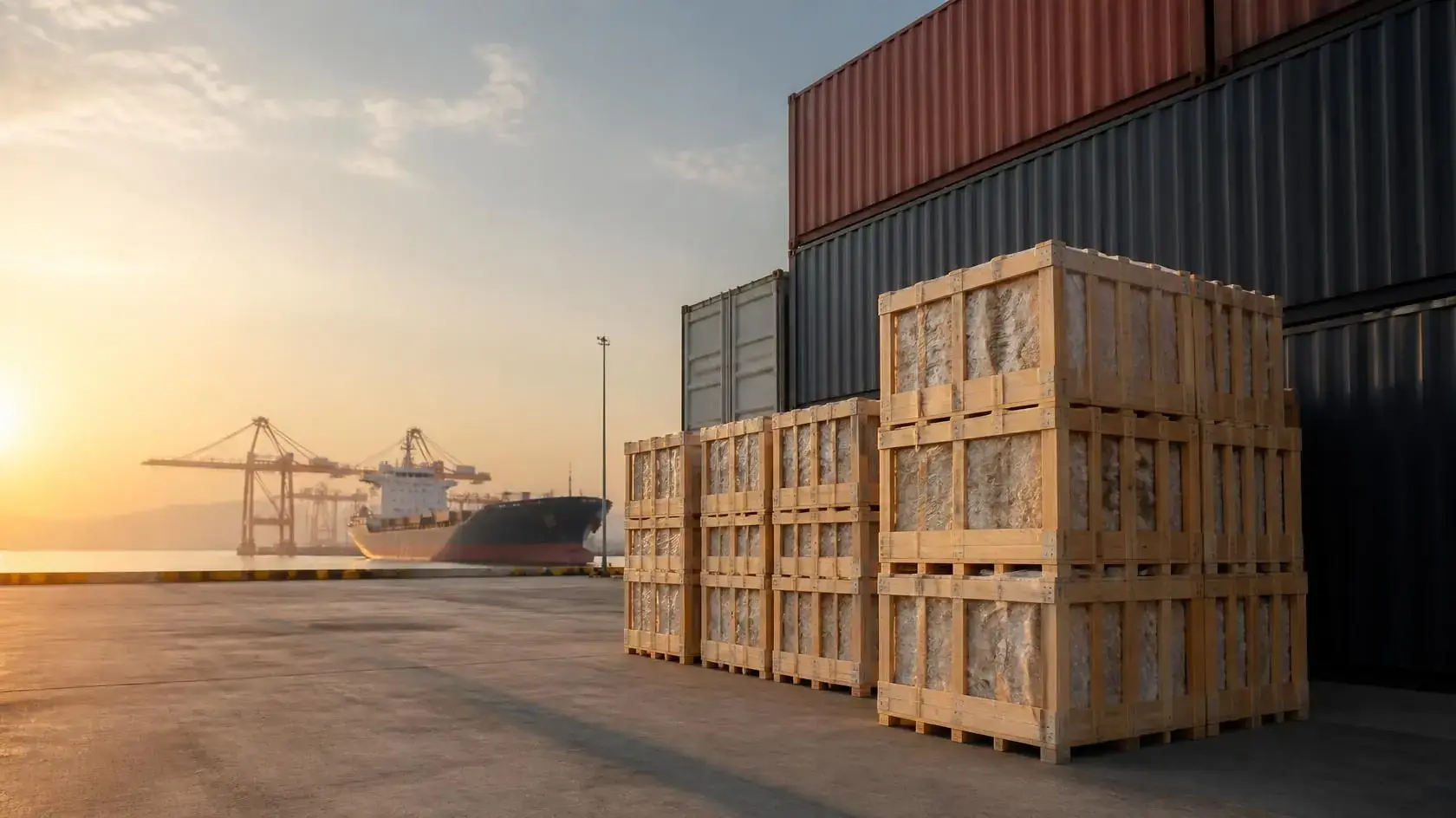
Stone that arrives chipped is stone you cannot sell, and freight and duty have already been paid on it. Reasonable packing for a sea voyage means:
- Faces interleaved with foam or paper
- Edges and corners protected, particularly on coping and profiled pieces
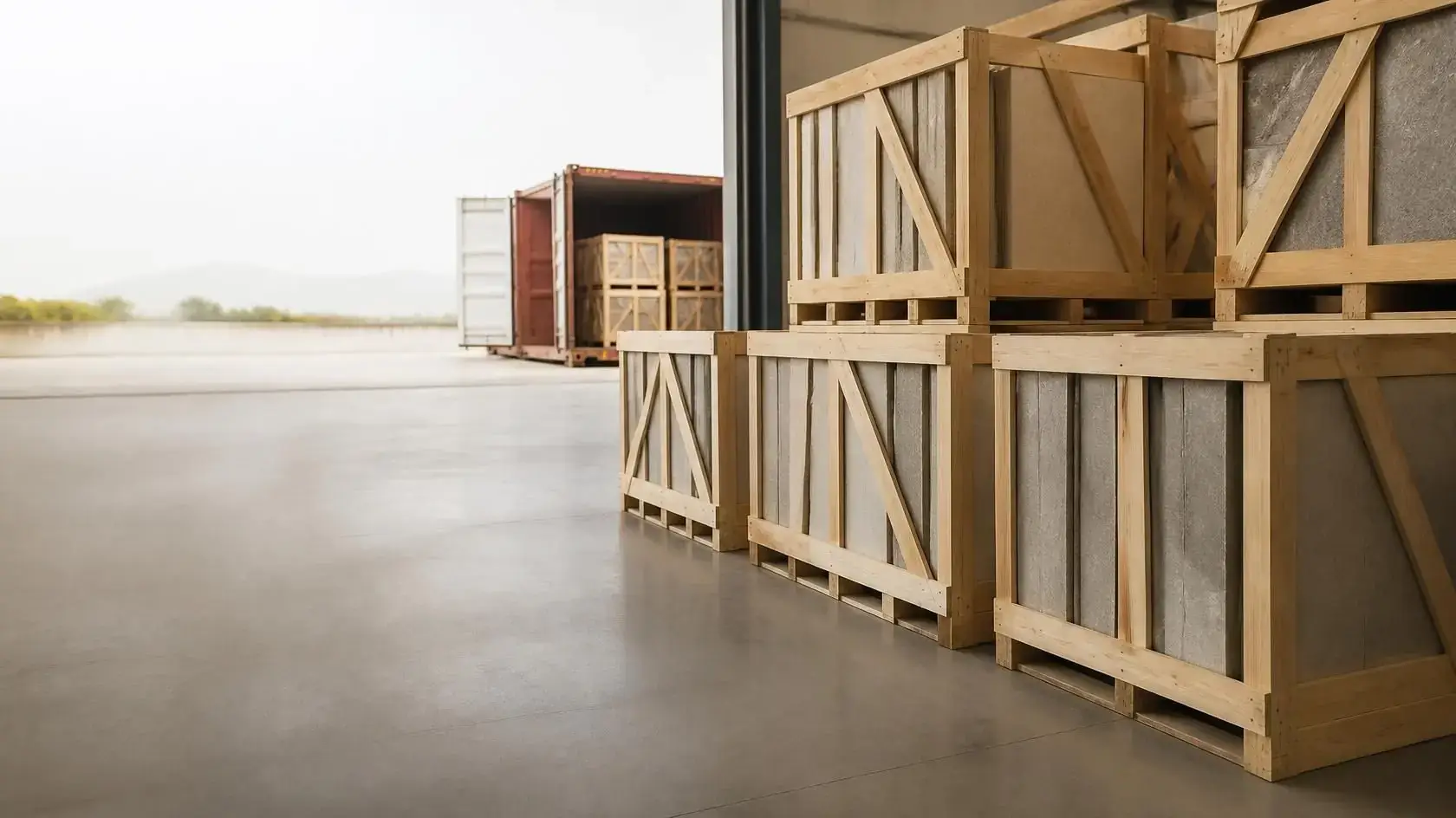
- Crates or pallets built from fumigated timber, strapped and closed
- Each crate marked with product, size, finish and quantity — and, on project orders, with the pool area or elevation it belongs to
- A loading plan that distributes weight and stops crates shifting
Ask what the packing specification is before you order. Packing varies by product, size, destination and buyer requirement, and a supplier who cannot describe it in detail has probably not thought about it.
8. Documentation
Standard export documentation is issued per shipment. If your country requires additional certificates, specific wording, or documents legalised in a particular way, tell the supplier at order stage. Requirements differ significantly between markets, and the time to discover a missing document is not when the container is already at your port.
Your customs broker will tell you exactly what your import requires. Send that list to the supplier early.
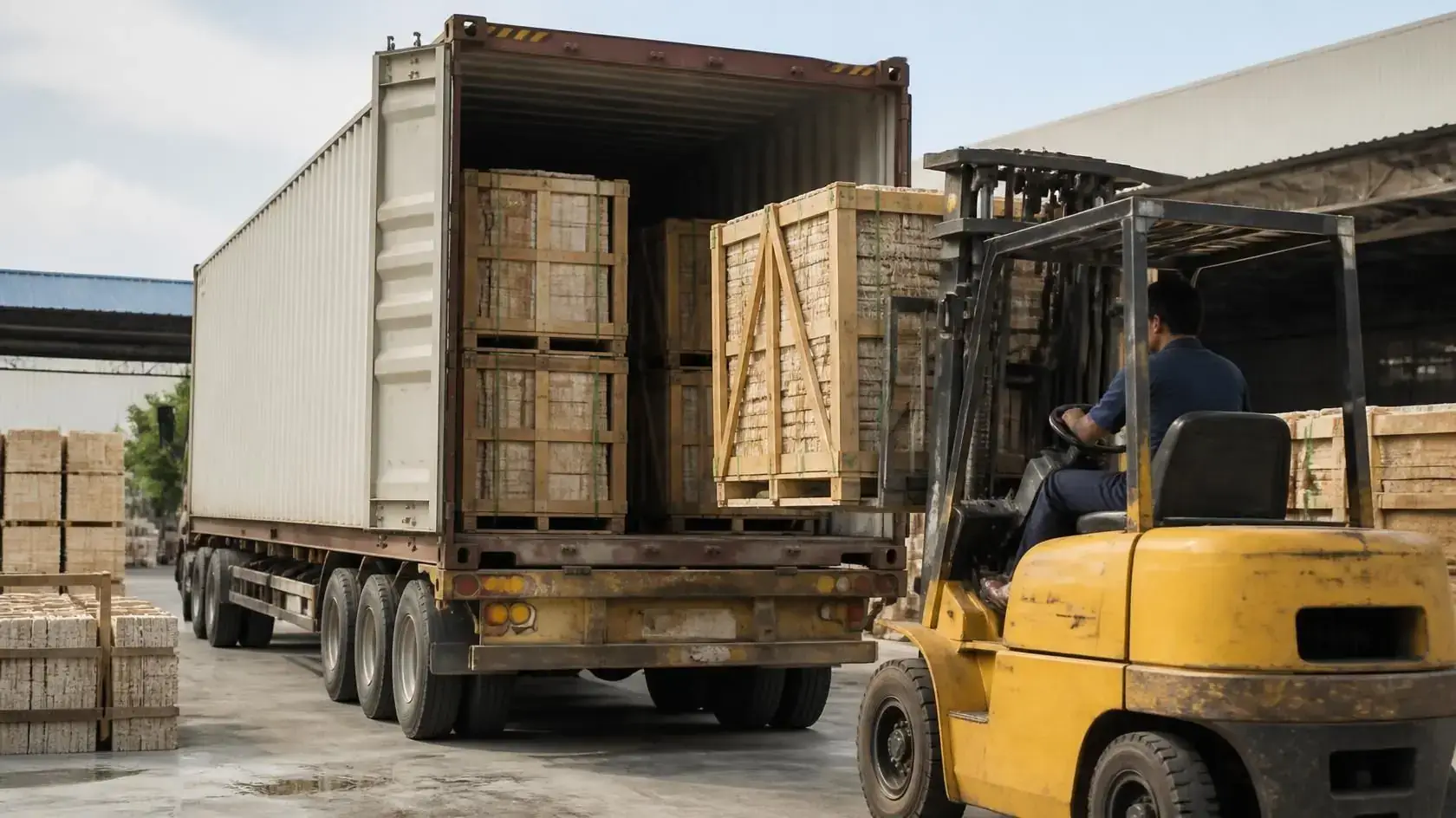
9. Arrival and unloading
When the container is opened:
- Photograph the crates before anything is moved
- Check crate marks against the packing list
- Open crates in the order they will be installed, not all at once
- Check quantity, size and finish against the specification
- If there is damage, photograph the crate, the packing and the pieces together, and report it immediately with the crate marks
Damage claims are decided on evidence. Photographs taken before unloading are worth more than any description written afterwards.
10. Plan the second order while the first is arriving
If you are stocking the material rather than building one project, note the batch reference on the approved control sample and keep spare material from the original run. Stone produced later comes from different blocks. For a distributor this is the difference between a saleable stock and a warehouse full of near-misses.
A short checklist
- Qualify the supplier — factory or broker?
- Agree the full specification in writing
- Approve a control sample, wetted where relevant
- Choose the Incoterm and confirm the port
- Get the quotation, then the proforma
- Confirm production time and plan backwards
- Arrange inspection or photographs before loading
- Confirm the packing specification
- Give the supplier your customs document list
- Photograph everything at arrival
Ready to start? Send your specification and our export team will prepare a quotation, or read the full export process step by step.
Need a quotation for your project?
Send the stone, size, finish, quantity and destination port. Our export team will come back with a quotation and, where useful, a recommendation.