7 min read Zeolite Factory
Pool designers choosing between natural stone and ceramic or porcelain tile are usually deciding between two different sets of trade-offs rather than between a better and a worse product. We supply the stone, so treat this as a supplier’s view — but a supplier’s view that tells you where ceramic is the more sensible choice.
Appearance
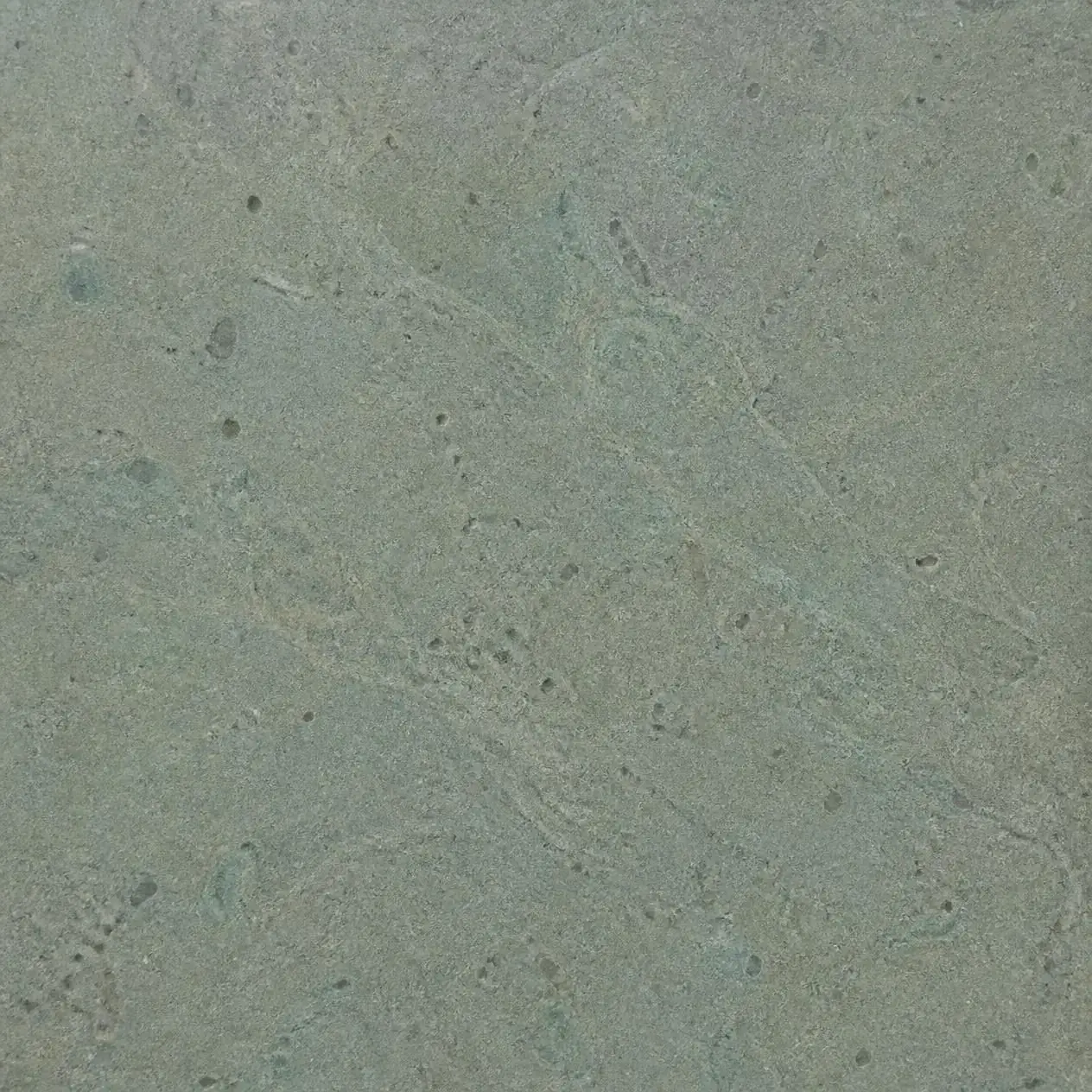
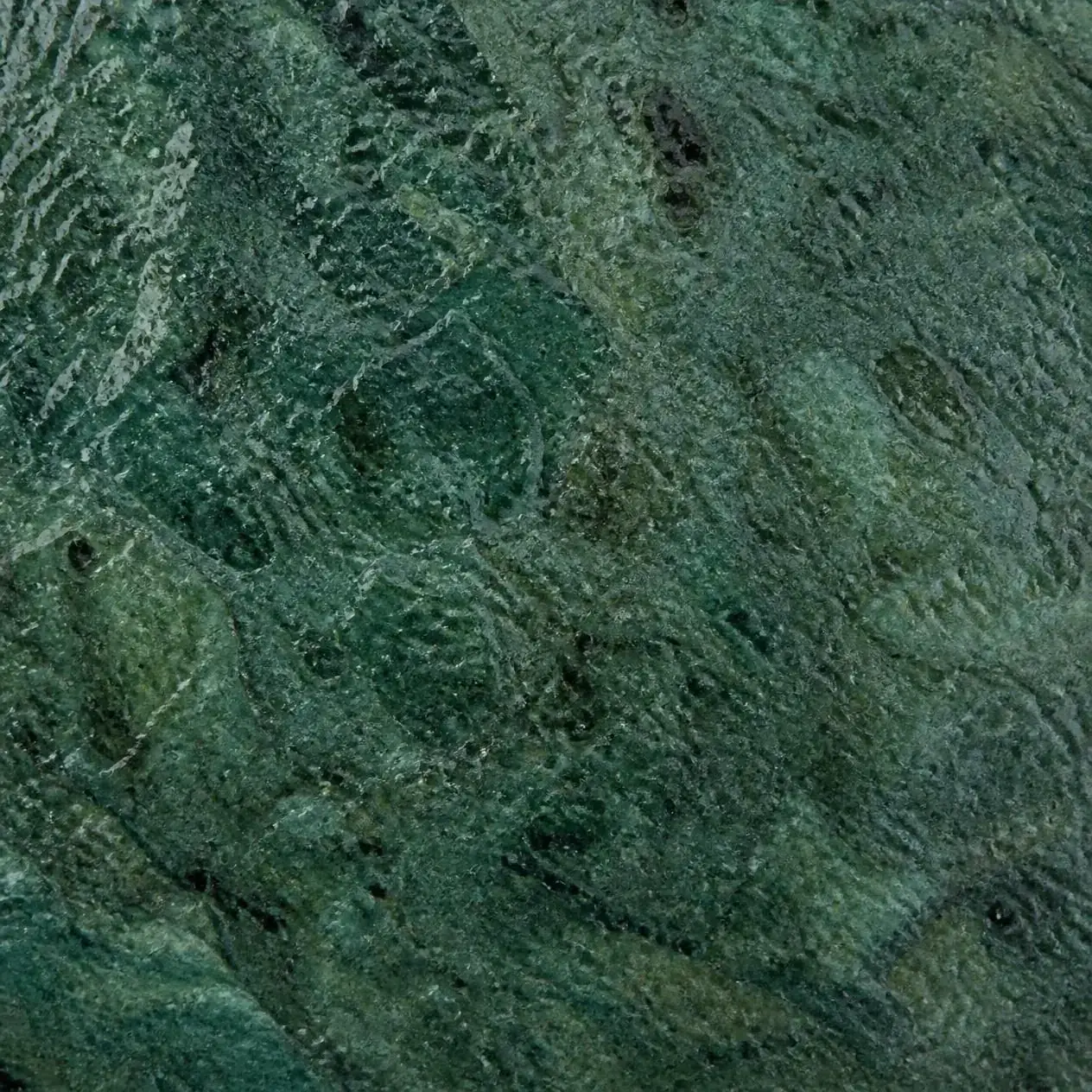
Natural stone. Sukabumi Green Stone is porous and unglazed. Under water the tone deepens and the natural movement inside the material becomes visible, which produces a green that changes with depth, light and time of day. No two pools look the same, and no two tiles are identical.
Ceramic and porcelain. Manufactured to a repeating pattern. Colour is consistent from box to box and from year to year. High-quality porcelain can imitate stone convincingly on a dry sample; under moving water, a repeating printed pattern tends to become apparent because the eye picks up the repeat.
The honest summary: if the project is specified on the strength of the pool’s colour and the way it changes, that is exactly what natural stone provides. If the project needs a controlled, repeatable, matching finish across many identical pools, ceramic does that better.
Variation and matching
Stone varies between blocks and batches. This is managed — a control sample, an agreed colour range, sorting across the whole order — but not eliminated. Reordering two years later will not produce an exact match.
Ceramic is produced in controlled batches with published shade codes and can usually be re-ordered from the same production reference for a period.
Practical consequence: with stone, buy your spares with the original order.
Installation
Both materials need a competent installer, but the demands differ.
Natural stone in permanent immersion needs an adhesive, grout and waterproofing system rated for that use, and typically a sealing regime chosen for the local climate and water chemistry. Stone is heavier than ceramic of the same format, so the substrate and adhesive have to account for it. Cut edges are exposed material rather than a glazed finish, so the quality of on-site cutting shows.
Ceramic and porcelain are lighter and dimensionally consistent, which makes laying faster and setting-out more predictable. Porcelain is dense and low-absorption, so it does not normally require sealing.
Practical consequence: stone rewards an experienced pool installer and punishes an inexperienced one more than ceramic does.
Maintenance
Porous stone interacts with water chemistry. Unbalanced water, aggressive chemical dosing or sustained neglect will affect the surface over time, and some owners choose to reseal periodically. Glazed ceramic and dense porcelain are more forgiving of poor water management.
On the other hand, stone weathers rather than fails cosmetically — the surface develops a patina, and small variations read as character. Damage to a glazed tile is visible immediately and permanently.
Practical consequence: if the pool will be maintained by a professional operator — a hotel or a managed villa — stone is straightforward. If it will be left to fend for itself for long periods, factor that into the decision.
Cutting, coping and complex geometry
This is where stone often wins on a custom pool. Because it is cut to order, elements can be produced to the exact drawing: step treads with a finished nosing, coping with a bullnose or a rebated overflow profile, mitred corners, radius pieces for curved pools. See the pool coping page for profiles.
Ceramic ranges include trims and edge pieces, but you are limited to what the manufacturer produces. Complex custom geometry usually means on-site cutting and visible cut edges.
Lead time and logistics
Ceramic bought from a local distributor may be available from stock in days.
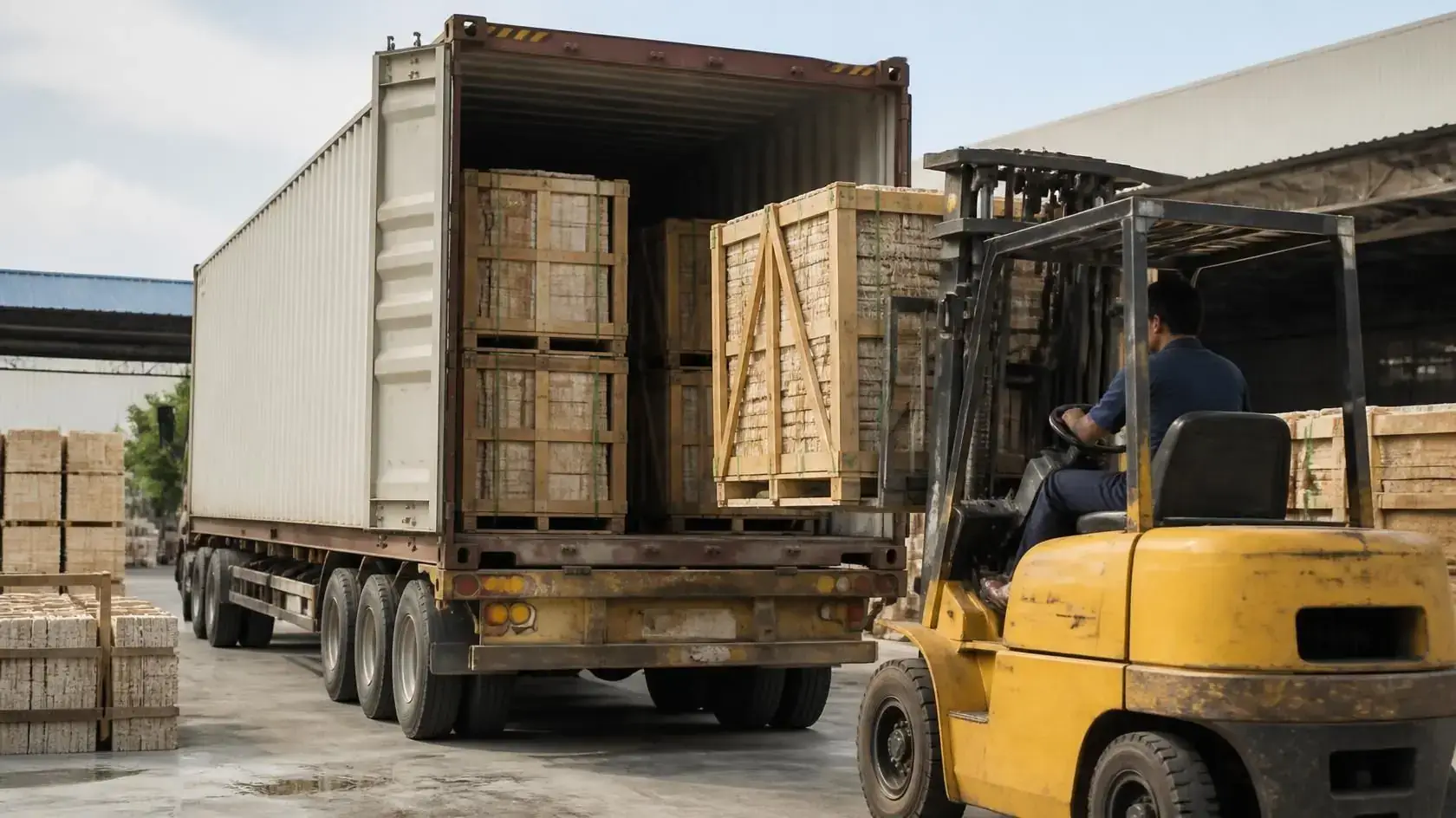
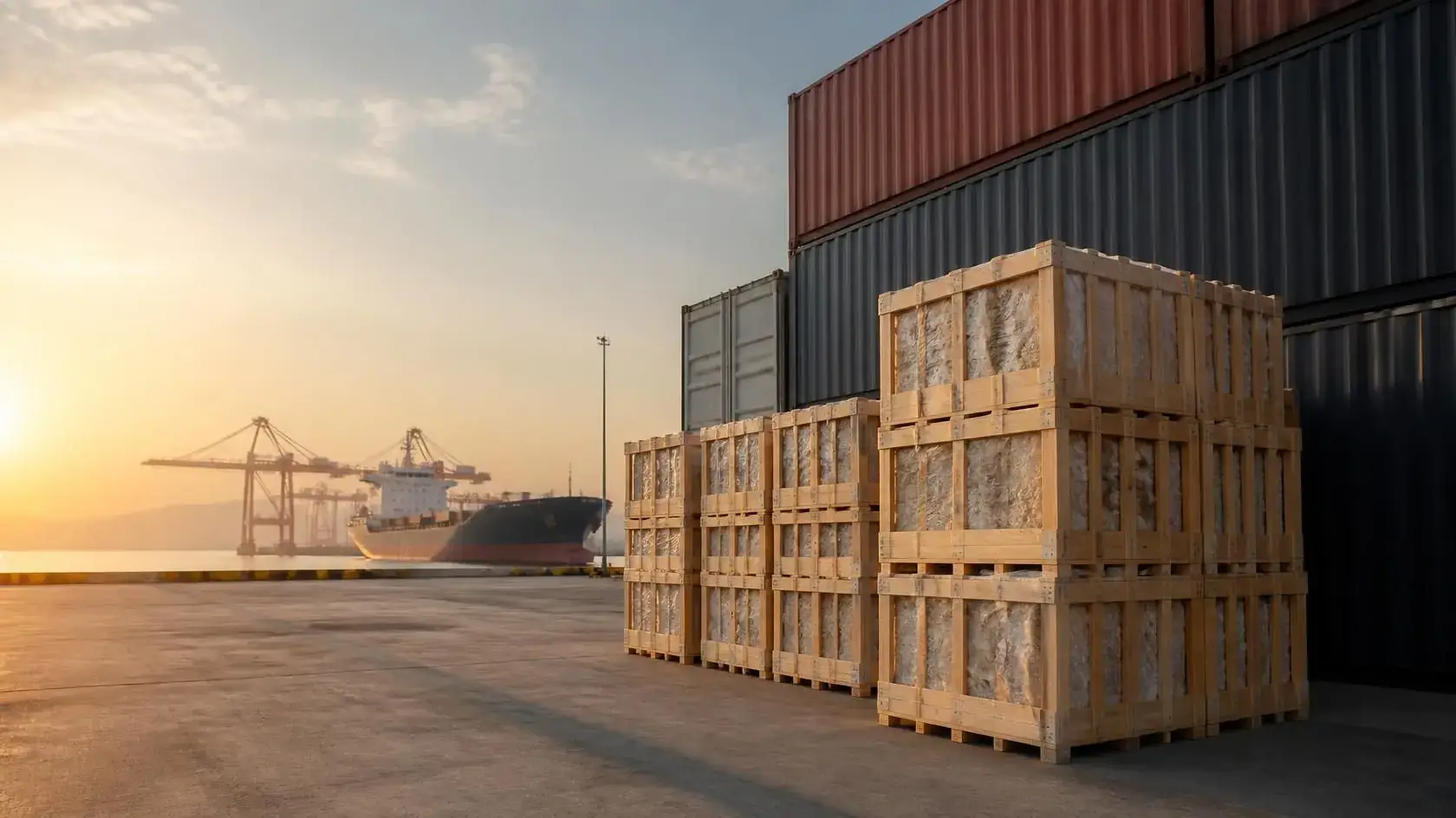
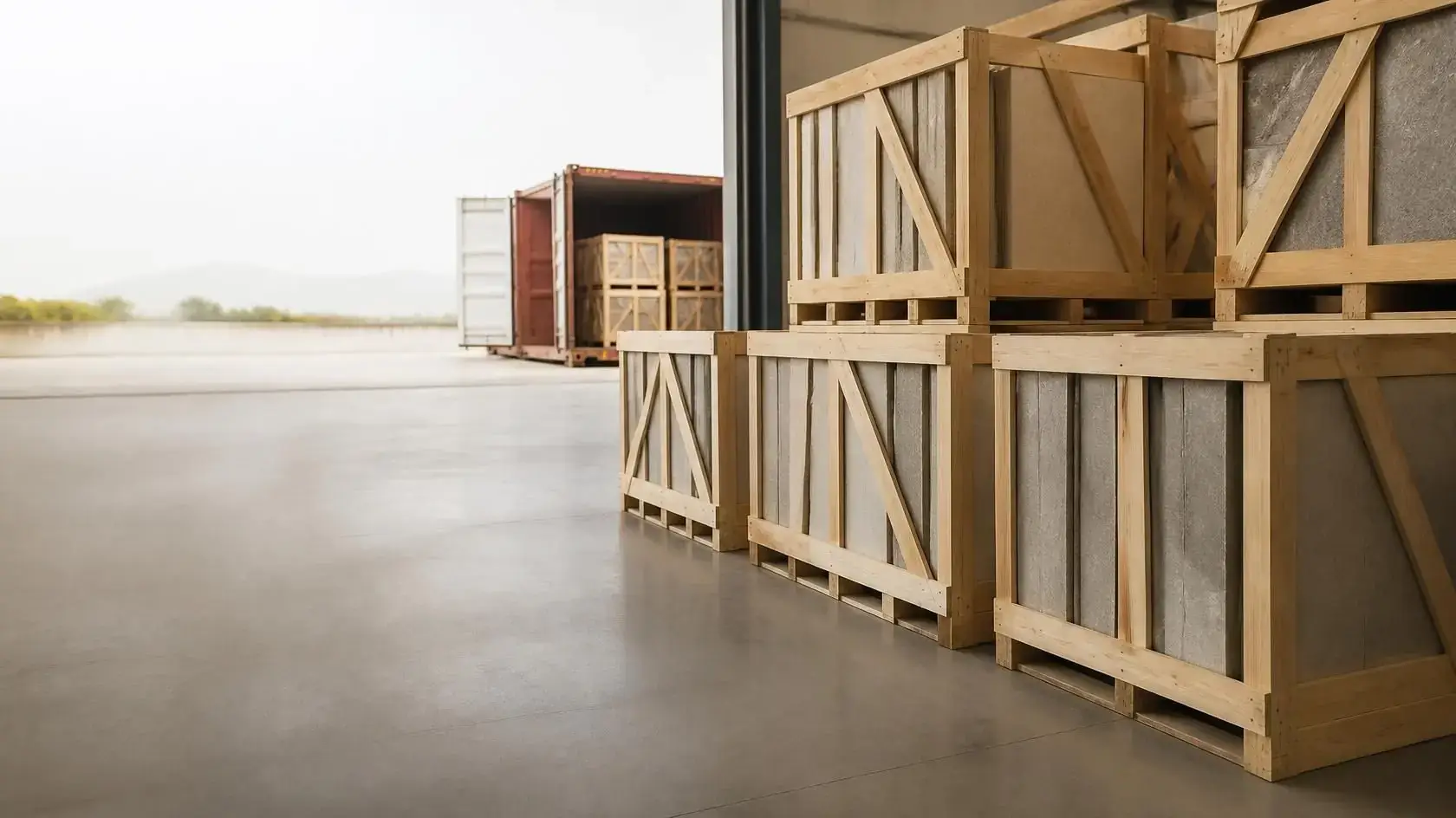
Natural stone from Indonesia is a production and shipping exercise: production time, packing, container loading and sea transit to your port. The full sequence is set out on our export process page. This has to be planned backwards from the date the material is needed on site — it is not a decision that can be left until the shell is finished.
Practical consequence: stone belongs in the programme early. If your pool is being tiled in six weeks and nothing has been ordered, ceramic from stock is the realistic answer.
Cost structure
We do not publish prices, because a stone quotation depends on the size, thickness, finish, quantity, destination port and Incoterm. But the shape of the cost is worth understanding:
- Ceramic: material cost plus local delivery. Predictable, and usually lower for a small pool.
- Natural stone from Indonesia: material plus packing, freight, insurance, import duty and local handling. Freight is a meaningful share on a small order and a small share on a full container — which is why the cost per square metre falls sharply as the order approaches a full container.
For a single small residential pool, the total delivered cost of imported stone can be hard to justify. For a villa with a pool, deck, cladding and basins, or for a resort with several pools, consolidating everything into one container changes the arithmetic considerably. That is why we quote mixed containers for villa and hospitality projects.
Where we would recommend ceramic
Plainly: if the project needs guaranteed batch matching across many identical units; if the programme cannot accommodate production and sea freight; if the pool will receive minimal maintenance; or if the quantity is too small for the freight cost to make sense. We would rather tell you that at enquiry stage than ship a container that disappoints.
Where the stone earns its place
A pool whose colour is the point of the design. A villa or resort where the same material runs from the pool into the deck, the walls and the bathrooms. Complex geometry that needs pieces cut to a drawing. And projects where the client wants a surface that is unmistakably natural and unmistakably not a printed pattern.
If that is your project, send us the drawing and the specification and we will quote it.
Need a quotation for your project?
Send the stone, size, finish, quantity and destination port. Our export team will come back with a quotation and, where useful, a recommendation.