6 min read Zeolite Factory
This is one of the most common questions we get, and the honest answer is: it depends on the thickness, and the limit is weight, not space. Here is how to work it out for your own specification.
Weight is the constraint, not volume
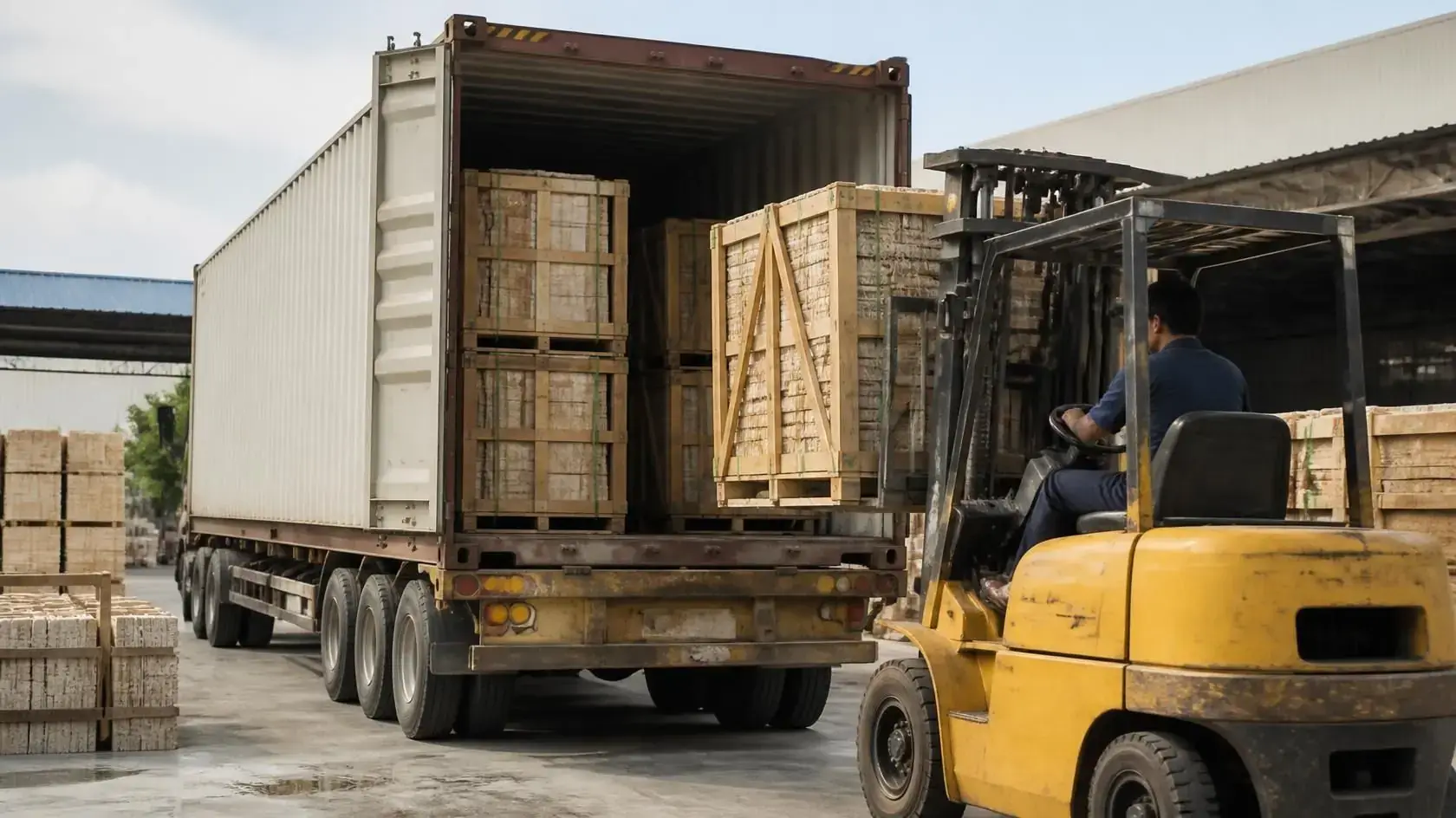
A container full of stone reaches its weight limit long before it runs out of room. Crated stone is dense, and a 20ft container loaded with tile is typically only part-filled by volume when it hits its payload limit.
That means the useful question is not “how many square metres fit?” but “how many square metres weigh what a container can legally carry?”
Typical container payloads
As a general planning guide:
| Container | Typical tare weight | Typical maximum payload |
|---|---|---|
| 20ft dry | around 2,200 kg | roughly 25,000 – 28,000 kg |
| 40ft dry | around 3,700 kg | roughly 26,000 – 28,000 kg |
Two important caveats. First, these are general figures — the actual limits depend on the container, the carrier and the shipping line’s rules. Second, road transport limits at the destination frequently cap the practical payload well below the container’s technical maximum, and those limits vary by country and even by region. Your forwarder is the authority here, not your stone supplier.
Notice that a 40ft container does not carry twice the weight of a 20ft. For dense cargo like stone, a 20ft container is often the more efficient unit; 40ft becomes useful when the cargo mixes heavy tile with lighter or bulkier items.
The calculation
The method is simple arithmetic:
Step 1 — find the weight per square metre of your tile.
weight per m² (kg) = thickness (m) × density (kg/m³)Step 2 — add the packing weight. Crates, pallets, interleaving and strapping add meaningfully to the shipped weight. Plan on the packed weight, not the bare stone weight.
Step 3 — divide the payload by the packed weight per square metre.
square metres per container = usable payload (kg) ÷ packed weight per m² (kg)A worked example
Take a 20 mm tile. Suppose — purely as an illustration — the material weighs 50 kg per square metre at that thickness, and packing adds around 10 per cent:
- Packed weight per m² ≈ 55 kg
- Usable payload, planning conservatively at 24,000 kg
- 24,000 ÷ 55 ≈ 435 m²
Change the thickness and the answer changes proportionally. At 30 mm the same material would be roughly 1.5 times heavier per square metre, so the same container carries around two thirds of the area. At 15 mm it carries considerably more.
The figures above are an illustration of the method, not a specification. Density varies between stone types and between blocks, and packing weight varies with the crate design. Ask your supplier for the packed weight per square metre for your actual product, thickness and packing — that is the only number worth calculating from. We provide it per order rather than publishing blanket figures we have not verified for the batch in question.
Rules of thumb worth knowing
- Thickness dominates everything. Going from 20 mm to 30 mm reduces the area per container by roughly a third. If the specification allows a thinner tile, the freight cost per square metre falls sharply.
- Coping and step pieces are heavy. They are thicker than flat tile and often crated more protectively. A pool package with a lot of coping carries less total area than a flat-tile order of the same value.
- Mixed containers are normal. Villa and landscape projects rarely need a full container of one item. Combining several stones and formats into one shipment gets the project to full-container economics — see the export page.
- Leave room in the plan. Loading to the absolute theoretical maximum leaves no margin for a heavier-than-expected crate. We plan to a working payload, not a theoretical one.
Why this matters for your landed cost
Freight is charged per container, not per square metre. So the delivered cost per square metre falls as the container fills toward its payload limit, and a part-filled container is expensive per unit.
For buyers whose project is smaller than a container, the options are usually: add other products from the same supplier to fill the container; consolidate with another buyer through a forwarder; or accept LCL (less than container load) shipping and its higher per-unit handling cost. We are happy to advise on which makes sense for your quantity — including telling you when the quantity is too small for imported stone to be economic.
What to send us for an accurate figure
- Stone type and finish
- Tile size and thickness
- Total area or the element breakdown
- Destination port
- Whether the container will be loaded with a single product or mixed
With that we can confirm the packed weight, the number of containers required and quote the freight component on CFR or CIF terms.
Send your specification and we will do the arithmetic with real numbers for your order.
Need a quotation for your project?
Send the stone, size, finish, quantity and destination port. Our export team will come back with a quotation and, where useful, a recommendation.